


Why Understanding Uptown Chicago's Safety Profile Matters
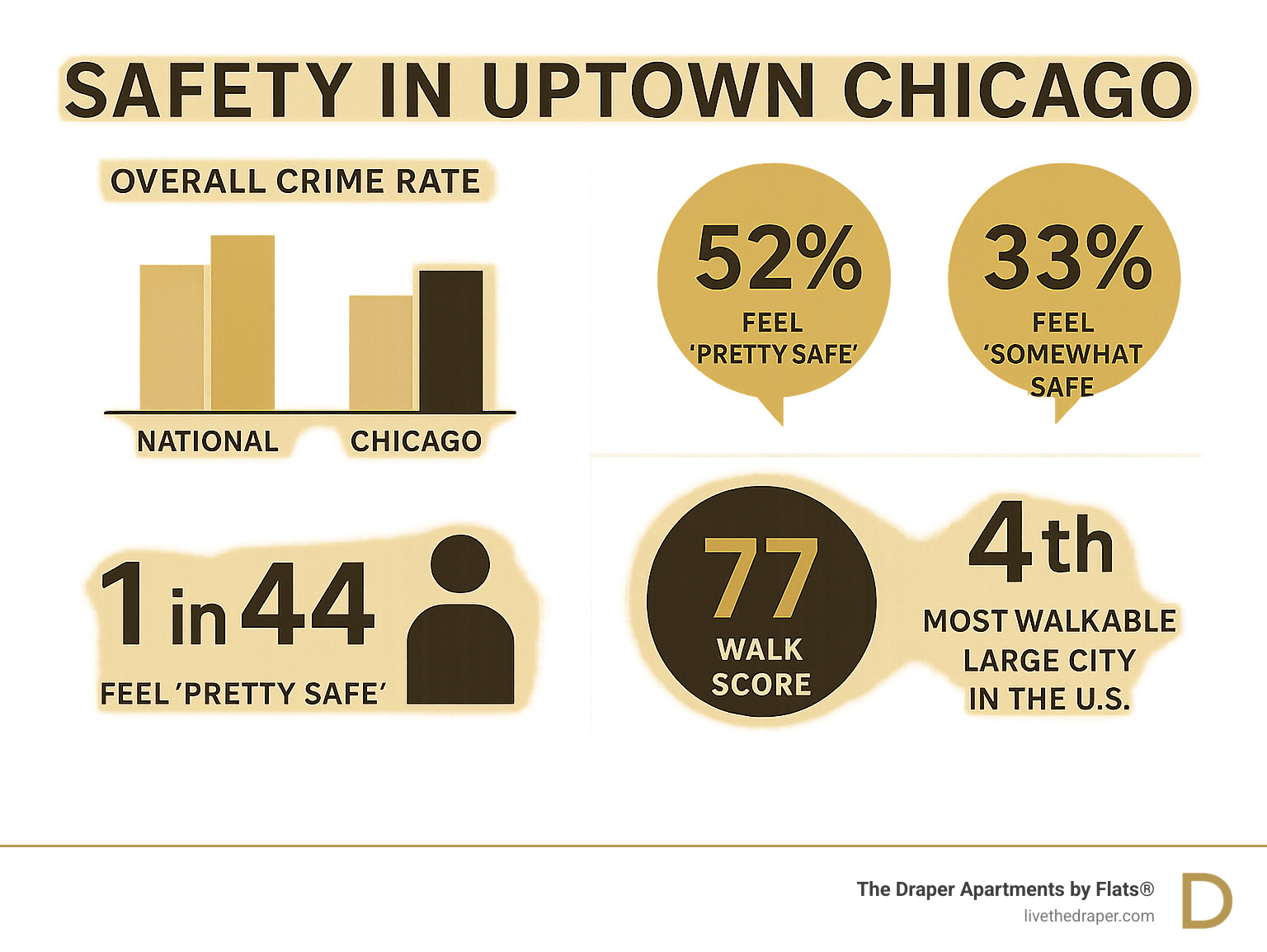
Safety in uptown chicago is a key consideration for anyone looking to live in or visit this vibrant North Side neighborhood. Based on FBI crime data and resident surveys, here's what you need to know:
Quick Safety Overview:
- Overall crime rate is 2% lower than the national average
- Violent crime is 10% lower than national average
- 52% of residents feel "pretty safe"
- 33% consider it "somewhat safe"
- Likelihood of becoming a crime victim: 1 in 44
- Property crime risk is above average (focus on auto theft and larceny)
Uptown Chicago presents a complex safety picture that defies simple answers. This eclectic neighborhood, stretching along Lake Michigan's shoreline, has experienced significant change over recent decades. Historic entertainment venues like the Riviera Theatre sit alongside diverse dining options and busy transit hubs.
The neighborhood's character varies considerably from block to block. Areas near the lakefront and main corridors like Broadway tend to feel different than pockets closer to certain CTA stations. Understanding these nuances helps residents and visitors make informed decisions about where to go and when.
Recent city-wide trends show promise. Chicago has seen decreases in homicides and shootings, with specialized task forces reducing firearm-related robberies by 33% and carjackings by 26% in 2024. The city recovered over 12,000 illegal guns last year alone.
For those considering Uptown as home, the data suggests a neighborhood that's statistically safer than many expect, while still requiring the street awareness that comes with urban living.
Understanding the Numbers: A Look at Uptown's Crime Statistics
When we talk about safety in Uptown Chicago, it helps to start with solid facts rather than rumors or assumptions. The most reliable picture comes from the FBI's Uniform Crime Reports, which gather data from over 18,000 law enforcement agencies across the country. This comprehensive system covers about 98% of metropolitan areas and gives us a trustworthy foundation for understanding what's really happening in the neighborhood.

Overall Crime Rates in Context
Here's something that might surprise you: Uptown's overall crime rate sits 2% lower than the national average. That's right - despite its urban reputation, you're actually slightly less likely to encounter crime here than in the average American community.
The violent crime picture looks even better, coming in 10% lower than the national average. This covers serious offenses like assault, robbery, and murder - the crimes that tend to worry people most when they're thinking about where to live.
Now, let's put this in practical terms. Your chance of becoming a crime victim in Uptown works out to about 1 in 44. While no one wants to think about becoming a statistic, this context helps frame the actual risk you're facing day to day.
The overall crime grade comes out as "high (D)" when measured against ideal conditions. This reflects the reality of living in a busy urban environment rather than a quiet suburb.
A Closer Look at Violent and Property Crime
The numbers tell different stories depending on which type of crime we're examining. Violent crime risk gets a "high (D)" rating, while property crime lands at "above average (D+)." This means you're more likely to deal with someone messing with your car or bike than facing a violent encounter.
Let's break down what this actually means for your daily life. For violent crimes, the risks vary significantly. Murder and homicide risk rates as "high (D)," similar to Chicago overall and somewhat above the national average. Robbery also gets a "high (D)" rating - much higher than the US average but typical for Chicago.
Aggravated assault follows the same pattern with a "high (D)" risk level. The rape risk is "above average (D+)," and crimes against women overall rate as "high (D)," which is concerning and something the community continues to address.
When it comes to property crimes, the story gets more specific. Burglary risk sits at "average (C+)" - not great, but not terrible either. Larceny (think pickpocketing, shoplifting, or someone grabbing your phone) gets a "high (D)" rating, especially in busy areas where tourists and commuters mix.
Auto theft stands out as a particular concern with a "very high (D-)" risk rating. This reflects a citywide trend that's been challenging Chicago and many other major cities. Arson comes in at "above average (D+)," though this affects far fewer people in practical terms.
How Uptown Ranks Within Chicago
Here's where things get interesting. When you stack Uptown against Chicago's other 218 neighborhoods, it actually performs pretty well. The neighborhood ranks 79th for overall crime, putting it in the top half of Chicago areas for general well-being.
For violent crime specifically, Uptown sits at 80th place - again, better than more than half of Chicago neighborhoods. Property crime tells a different story at 116th place, reflecting those higher rates of auto theft and larceny we mentioned.
These rankings reveal something important about safety in Uptown Chicago: while property crime remains a real concern, the neighborhood performs significantly better than many other parts of the city when it comes to violent crime. This distinction matters when you're thinking about your daily comfort and peace of mind living here.
The granular numbers show Uptown ranking 52nd for murder, 53rd for both robbery and aggravated assault, and 53rd for auto theft among Chicago neighborhoods. For burglary, it sits at 123rd, while larceny comes in at 86th. Interestingly, arson ranks quite low at 14th, though this affects very few residents in practice.
The Resident Experience: Perceptions of Safety in Uptown Chicago
When it comes to safety in Uptown Chicago, the numbers only tell part of the story. What really matters is how people actually feel living here day to day. The good news? Most residents feel reasonably secure in their neighborhood, though experiences vary quite a bit from person to person.

What Locals Say About Neighborhood Atmosphere
The community feeling in Uptown is generally positive, with resident surveys painting a picture of cautious optimism. More than half of residents (52%) feel "pretty safe" in their neighborhood, while another 33% consider it "somewhat safe." Only a small portion - about 9% - feel unsafe, and 5% feel very secure.
This mixed but mostly positive outlook reflects the reality of urban living. Some long-time residents share stories of walking their dogs at night without worry, while others prefer staying indoors after dark. One local mentioned regularly jogging in the evening and feeling comfortable, with their spouse often walking home from the community garden at twilight.
However, not everyone shares this comfort level. Some residents have noticed changes over the years, with a few mentioning increased concerns about property crime. One 15-year resident noted their car being damaged recently, while another mentioned a neighbor's vehicle being vandalized and stolen.
When it comes to law enforcement visibility and community engagement, residents generally feel well-served. About 52% find police "very visible and very responsive," which contributes significantly to the overall sense of security. Another 14% find officers visible but slower to respond, while 14% feel police presence is lacking.
The neighborhood benefits from active community engagement, including regular CAPS (Chicago Alternative Policing Strategy) meetings where residents can discuss concerns directly with local law enforcement. This connection between community members and police helps address issues before they become bigger problems.
Navigating Uptown: Areas of Note and Nighttime Awareness
Like any diverse neighborhood, safety in Uptown Chicago varies considerably depending on where you are and when you're there. Understanding these geographic variations helps residents and visitors make informed choices about their daily routines.
Buena Park stands out as one of the most comfortable areas within Uptown. This tree-lined sub-neighborhood has a quieter, more residential feel that many find reassuring. The well-maintained streets and active community presence contribute to its reputation as a particularly welcoming spot.
The area around the Wilson Red Line station requires more awareness, especially during late hours. Like many busy transit hubs, it sees higher foot traffic and can feel less predictable after dark. This doesn't mean it's dangerous, but many locals suggest staying alert when passing through.
The Uptown Entertainment District Chicago brings its own dynamics to neighborhood life. While the historic venues and busy nightlife create energy and community, they also mean more people moving around at night. Most residents enjoy this vibrancy while maintaining basic urban awareness.
Nighttime safety requires extra consideration throughout Uptown. Crime statistics show significantly higher incidents between 10 PM and 6 AM, which aligns with patterns in urban areas nationwide. Many residents adapt by traveling in groups, using rideshare services, or sticking to well-lit main streets when out after dark.
Despite these precautions, plenty of people still enjoy Uptown's evening offerings. The key is finding the right balance between enjoying everything the neighborhood has to offer - from its benefits of living in Uptown Chicago to its vibrant community life - while staying aware of your surroundings.
City-Wide Context and Practical Safety Tips
Understanding safety in Uptown Chicago also requires placing it within the broader context of Chicago's public safety landscape. The city has been actively working to address crime, and these efforts often have ripple effects on neighborhoods like Uptown.

Chicago's Evolving Public Safety Landscape
Chicago has seen some encouraging shifts in its crime trends recently. For instance, in 2024, homicides decreased, marking the lowest number since 2019. We've also seen a decline in shooting incidents and victims compared to the previous year. Even overall robberies showed a notable decrease. It's a positive sign for the city as a whole. You can explore more about these trends in the Chicago Police Department's crime statistics, which show a downward trend.
Mayor Brandon Johnson's administration has played a part in these reductions. They've highlighted decreases across various crime categories, including homicides, shootings, carjackings, robberies, and sexual assaults. Special task forces have been quite effective, for example, cutting firearm-related robberies and carjackings significantly. The city has also made big strides in recovering illegal firearms, seizing over 12,000 last year alone, and launching new initiatives like the Crime Gun Intelligence Center. While there are still challenges, such as aggravated assaults reaching a 20-year high in 2024, the general direction of these trends offers a glimmer of positive change for residents across the city, including those enjoying life in Uptown.
Practical Tips for Residents and Visitors
Whether you're a long-time resident or just visiting, adopting practical safety measures can significantly improve your experience in Uptown. We believe that an informed approach to urban living is the best approach, helping you feel more comfortable and confident as you explore everything this vibrant neighborhood has to offer.
Here are some personal safety recommendations to keep in mind:
- Stay Aware: Always be mindful of your surroundings, especially when walking alone or at night. Try to avoid distractions like constantly looking at your phone. It's wise to trust your instincts; if a situation feels off, it probably is.
- Nighttime Navigating: When you're out after dark, try not to walk alone. It's a good idea to opt for trusted rideshares or public transportation, or better yet, go with a group of friends. Stick to well-lit, main thoroughfares, which tend to be busier and more visible.
- Secure Your Space:
- Homes/Apartments: Consider boosting your security with two locks on exterior doors and making sure all windows, especially on ground floors, are properly secured. Using timer switches for lights when you're away can give the impression that someone is home, which can deter potential burglars. Even a basic DIY alarm system or a video doorbell can add an extra layer of protection and peace of mind.
- Vehicles: Given the "very high" risk of auto theft, we strongly recommend extra layers of car security. Think about adding a kill switch, a wheel lock, or a steering wheel lock. And remember, never leave anything valuable in your car, not even tucked away in the trunk. Always be extra aware of your surroundings when parking or returning to your vehicle. A GPS tracker with geofencing can also be a helpful tool for keeping tabs on your car's location.
- Protect Personal Items: When you're in crowded areas, keep a hand on your belongings. Try to avoid openly displaying expensive items like jewelry or electronics. Consider using an anti-theft bag with features like slash-proof straps and RFID blocking. For wallets, a "decoy" wallet with just a small amount of cash can be a clever deterrent against pickpockets.
- Public Transit Know-How: Public transportation is a convenient way to get around Uptown and the rest of Chicago. While generally safe, always remain aware of your surroundings, especially during off-peak hours or at less busy stations.
- Enjoying Uptown's Nightlife: Uptown is famous for its fantastic live music venues and a truly vibrant nightlife! While you're out enjoying these experiences, try to stay sober enough to remain alert and spot any potential trouble. If you ever find yourself in a threatening situation, especially if a weapon is involved, it's safest to give the assailant what they want immediately. Your safety is always the most important thing. For added confidence, you might even consider taking some self-defense classes.
- Financial Smart Choices: When you need cash, use ATMs in safe, well-lit places, and try to do so during daylight hours whenever possible.
By keeping these practical tips in mind, you can steer Uptown with greater confidence and truly accept all the wonderful experiences this neighborhood has to offer, from a stroll through a park to grabbing a delicious coffee at one of the best coffee shops in Uptown.
Frequently Asked Questions about Safety in Uptown Chicago
It's natural to have questions when considering a new neighborhood, and we often hear specific queries about safety in Uptown Chicago. Let's explore some of the most common ones, sharing insights based on data and local experiences.
Is it safe to walk at night in Uptown?
When it comes to walking at night in Uptown, the data suggests exercising extra caution. Between 10 PM and 6 AM, crime levels are statistically "very high (D-)," aligning with national trends where violent crimes tend to increase after dark.
However, many residents do enjoy walking around Uptown after sunset. If you plan to be out at night, we strongly recommend sticking to well-lit, busy main thoroughfares. Try to avoid less populated or dimly lit areas. Whenever possible, walk with a companion or in a group. For longer distances or if you find yourself in an unfamiliar spot after dark, utilizing rideshare services or public transit can be a safer alternative. Uptown's vibrant music venues, like those we highlight in our guide to Chicago Live Music Venues, often mean late-night activity, so being extra vigilant in these lively areas is always a good idea.
What are the primary safety concerns in Uptown?
Based on our analysis, the most notable safety concerns in Uptown tend to be related to property crime. Specifically, auto theft carries a "very high (D-)" risk, which is a broader challenge across Chicago right now. Larceny, which includes things like pickpocketing or bag snatching, also presents a "high (D)" risk, especially in busy commercial zones where visitors might be less aware of their surroundings.
While violent crime risks such as murder, rape, robbery, and aggravated assault are also rated as "high (D)" or "above average (D+)" compared to national averages, it's important to understand that these are often considered "crimes of opportunity." This means that by being aware of your surroundings, avoiding risky situations, and taking steps to secure your belongings, you can significantly reduce your vulnerability. For instance, making sure you don't leave valuables visible in your car can help prevent auto break-ins, and keeping your wallet secure can deter pickpockets.
How do residents perceive law enforcement in Uptown?
Resident surveys give us a wonderful look into how locals feel about the police presence and effectiveness in Uptown. A majority of respondents, 52% to be exact, find the police to be "very visible and very responsive." This is a strong positive sign, indicating that many residents feel police are present in the community and will act when needed.
Of course, not everyone shares the exact same view. About 14% of residents find police "visible but slow to respond," and another 14% feel they are "not around and unreliable." While these figures point to some areas where improvement might be welcomed, the overall sentiment leans towards a generally effective police presence. This visibility and responsiveness play a big part in the sense of security among many residents, reinforcing the idea that law enforcement is actively engaged in addressing safety in Uptown Chicago.
Conclusion
When you step back and look at the complete picture, safety in Uptown Chicago tells a story that's more nuanced than any single statistic can capture. This neighborhood isn't just a collection of crime data points—it's a living, breathing community where real people have built their lives and found their place in the city.
Yes, Uptown faces urban challenges. Auto theft remains a genuine concern, and staying alert at night is simply smart city living. But these realities exist alongside something equally important: a neighborhood with genuine character and opportunity.
The lakefront beckons just blocks away. Historic venues like the Riviera Theatre anchor a thriving entertainment scene. Diverse dining options reflect the community's rich cultural mix. Tree-lined streets in areas like Buena Park offer pockets of residential calm. This is the fuller story of Uptown—one where being informed about potential risks allows you to fully accept everything the neighborhood offers.
Most residents—85% according to our data—feel either "pretty safe" or "somewhat safe" in their daily lives here. They've learned to steer the neighborhood with awareness while still enjoying evening strolls to local coffee shops, nights out at live music venues, and lazy afternoons by the lake.
The Draper Apartments offers a unique living experience in Uptown Chicago, providing modern studio to two-bedroom apartments with high-end amenities like a rooftop pool and fitness center. From here, you're perfectly positioned to experience both the energy of the entertainment district and the tranquility of the lakefront, all while enjoying the comfort of a thoughtfully designed home.
Making an informed decision about where to live means weighing all factors—the statistical realities, the resident experiences, and your own comfort level with urban living. Uptown rewards those who approach it with both awareness and openness to its unique blend of grit and charm.